Published on
Story by Logan Jackson
The Udall Foundation awards scholarships to college sophomores and juniors each year for leadership, public service and commitment to issues related to Native American nations or to the environment. The Udall Undergraduate Scholarship honors the legacies of Morris K. Udall and Stewart L. Udall, whose careers had a significant impact on Native American self-governance, health care, and the stewardship of public lands and natural resources.
The award requires a campus nomination and about 65 scholarships were awarded this year, including two to students from the University of Missouri.
Caspar Dowdy: Junior Environmental Sciences and Journalism Double Major, Pursuing the Honors College Certificate
Throughout their time as a Mizzou Tiger, Caspar Dowdy has combined their expertise in journalism with their interest in environmental issues to inform the public about complex scientific issues. The Udall Undergraduate Scholarship will allow them to share that message with wider audiences.
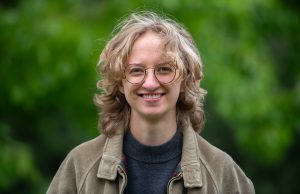
“I was definitely surprised to have been selected,” Dowdy said. “I was waiting in line to grab lunch before a class presentation and happened to check my phone shortly after Erik Potter sent me the email about it. Right away, I texted my family, but I didn’t tell anyone else because I was sure it was a mistake. It didn’t feel real until the next morning, when the Udall Foundation got in touch with me.
“I was excited, for sure, but also incredibly grateful for all of the people who helped me reach that point. I went to visit all of my recommendation letter writers the next morning. They’re some of the greatest mentors I’ve had in my time at Mizzou, and I wanted to make sure they were some of the first people to know, since I really could not have done any of this without their support.”
Dowdy is currently an undergraduate research assistant in the Center for Agroforestry, specifically in the laboratory of Chung-Ho Lin, a research professor in the School of Natural Resources. Dowdy’s research focuses on phytoremediation – using plants to break down and immobilize harmful contaminants – of agricultural soils impacted by organic pollution, with a particular focus on explosives like TNT. They also work with Lin’s wastewater bioinformatics team to monitor public health threats in sewersheds. Dowdy also works as a student reporter for KBIA public radio, where they are interested in stories tied to science, environment, agriculture and rural issues.
“Caspar’s passion for environmental reporting is driven by a deep concern for the planet and a desire to use science and storytelling to effect positive change,” Lin said. “I am confident that Caspar has the potential to make significant contributions to the field of environmental science if they pursue that path, but I believe Caspar will also excel as an environmental journalist. Caspar possesses a rare blend of creativity, scientific acumen and communication skills that set them apart as a future leader in environmental reporting. I look forward to seeing all that Caspar will accomplish in the years to come.”
Dowdy is excited to further their work through the scholarship.
“I’m looking forward to the opportunity to meet the other students in my cohort,” Dowdy said. “The network of Udall Undergraduate Scholarship alumni is vast, and there’s a lot of wonderful people within it.
“Our world is facing a lot of big problems, and the only way we can face them is if we start investing in solutions now. I’m grateful that the Udall Foundation believes in journalism’s ability to address environmental issues, and I’m incredibly humbled to be recognized as a part of that progress.”
Ben Walters: Junior Environmental Sciences and Natural Resource Science and Management Double Major
For Ben Walters, the Udall Undergraduate Scholarship will allow him to connect his research on ectomycorrhizal fungi and forest resilience with broader conversations about environmental policy and land stewardship.
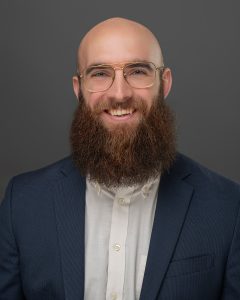
“Receiving the scholarship was genuinely overwhelming in the best possible way,” Walters said. “I was absolutely brimming with excitement and told anyone within earshot who I thought might share in the joy. More than anything, it felt affirming – not just personally, but as recognition that the work I hope to do in forest ecology and ectomycorrhizal systems matters.”
Walters, a U.S. Navy veteran, currently works in the laboratory of Morgan Davis, an assistant professor in the School of Natural Resources. Within the lab, Walters has georeferenced white oak trees, collected soil samples and explored how site conditions may shape mycorrhizal suitability. A mycorrhiza is a mutual association between a fungus and a plant.
This summer, Walters will begin a project at the Prairie Fork Conservation Area, in Sam Lord’s Soil Ecology Lab. Lord is an assistant research professor in the School of Natural Resources. Walters will map changes in ectomycorrhizal associations with white oak (Quercus alba) across a chronosequence. He’s especially interested in how fungal communities may help individuals better understand forest resilience and long-term ecosystem health.
“What stands out about Ben is not only his technical competence but the way he situates the work within broader environmental questions,” Lord said. “He understands that fungal community composition is not an isolated academic topic, but part of a larger conversation about forest resilience, biodiversity recovery and long-term land stewardship. In lab meetings and field discussions, he consistently connects our findings to restoration practice and management implications. He asks practical questions about how chronosequence data can inform policy decisions and on-the-ground restoration planning.”
The scholarship will allow Walters to continue this important research.
“Broadly, the Udall Undergraduate Scholarship opens doors that would have otherwise been much harder to reach,” Walters said. “The financial support is deeply meaningful for my family, but the larger opportunity is the community and platform it provides. I hope to use that platform to help make belowground ecological systems more visible in how we think about forest health.
“Opportunities like the Udall Undergraduate Scholarship are incredibly important due to the way they make hands-on, real-world research more feasible and visible. For students, they help turn academic interests into applied work with ecological and policy relevance. For me, that means taking research that begins in the soil – with roots, fungi and microbes – and connecting it to the larger decisions we make about conservation and the future of public lands.”