Published on
Story by Logan Jackson
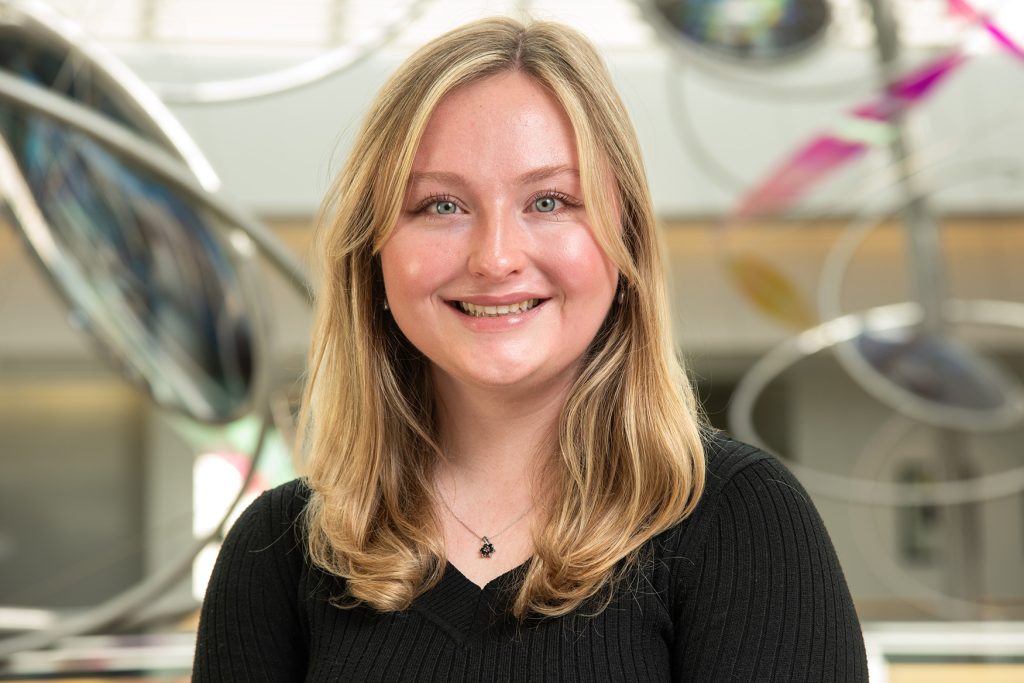
In less than two years at the University of Missouri, Sophie Hof has developed a solid research foundation, one that she will continue to build upon as a recipient of the prestigious Goldwater Scholarship.
The award is one of the most distinguished national scholarships in science, engineering and mathematics in the United States. A total of 454 Goldwater Scholarships were awarded for the 2026-27 academic year from more than 5,000 applicants.
“It was incredibly exciting to be named a Goldwater Scholar and a surprise!” said Hof, a sophomore biological sciences major who is pursuing the Honors College Certificate. “The Goldwater Scholarship is one of the most prestigious undergraduate awards in STEM, so being selected as a sophomore is a huge honor and really affirmed my commitment to pursuing research. I’m also very grateful for the support of Mizzou’s Office of Global and National Fellowships. They were incredibly supportive throughout this process.”
Hof’s first research experience came through the Freshman Research in Plants (FRIPS) Program, which is designed to expose new college students to plant research and to encourage them to consider a research career in plant biology. Hof was connected with Ron Mittler, a Curators’ Distinguished Professor in the Division of Plant Science and Technology, through the program.
“Sophie is a highly intelligent, mature and independent young researcher with the drive and long-term vision needed for a career in science. She has excellent scientific reasoning skills and grasps new ideas quickly. In our weekly lab discussions, Sophie consistently demonstrates strong reasoning skills and an impressive grasp of new ideas. She approaches research, coursework and teaching with professionalism and enthusiasm, and she will make excellent use of a Goldwater Scholarship.”
Rex Cocroft, professor of biological sciences, Hof’s faculty mentor at Mizzou
Hof has continued to work with Mittler after finishing the FRIPS Program and currently analyzes how increasing stomatal density in Arabidopsis thaliana, a small plant from the mustard family, influences development and stress responses. She also works in the laboratory of Rex Cocroft, a professor of biological sciences. Hof is investigating how treehoppers use vibrational communication to decide when to abandon poor hosts, with the goal of revealing fundamental mechanisms of cooperation and decision-making in group-living insects.
“Sophie is a highly intelligent, mature and independent young researcher with the drive and long-term vision needed for a career in science,” Cocroft said. “She has excellent scientific reasoning skills and grasps new ideas quickly. In our weekly lab discussions, Sophie consistently demonstrates strong reasoning skills and an impressive grasp of new ideas. She approaches research, coursework and teaching with professionalism and enthusiasm, and she will make excellent use of a Goldwater Scholarship.”
For the past two semesters, Hof has served as a teaching assistant for Sabrina Michael, an assistant teaching professor in the Honors College, including Michael’s current course, Blue Earth: Aquatic Science Through SCUBA.
She plans to use the scholarship to fund her future research endeavors. Hof said she plans to keep building on her projects in behavioral ecology and plant biology while planning for graduate study and a long-term career in research.
“Opportunities like this give students the chance to learn how to apply for national fellowships,” Hof said. “Personally, a major skill I developed was how to communicate my work to all types of audiences and show my enthusiasm in my applications. Overall, these opportunities help students learn how to communicate their work, develop strong applications for graduate school and programs like the NSF Graduate Research Fellowship (GRF).”